One of the smartest ways to prepare for the UPSC Civil Services Examination is by analyzing previous year question papers. If you have chosen Physics as your optional subject, then understanding the UPSC Physics Optional Previous Year Questions Analysis is essential for identifying important topics, recognizing question patterns, and planning an effective preparation strategy.
Between 2013 and 2025, UPSC has consistently tested conceptual understanding rather than rote learning. Candidates who regularly solved previous year papers were able to improve their answer-writing skills, strengthen conceptual clarity, and identify recurring themes.
In this article, we provide a detailed topic-wise analysis of UPSC Physics Optional Previous Year Questions (PYQs), highlight high-weightage topics, and share preparation tips to help you score higher in the UPSC Mains examination.
Why Analyze Previous Year Questions?
Previous year questions are more than just practice papers—they are a roadmap to understanding the examiner’s expectations.
Benefits of PYQ analysis:
Understand the UPSC question pattern
Identify high-weightage topics
Improve answer writing
Learn time management
Recognize recurring concepts
Build confidence for the examination
Students should regularly solve Physics Optional PYQ Solutions Topic Wise during their preparation.
Physics Optional Syllabus Overview
Before analyzing previous year questions, every aspirant should be familiar with the complete syllabus.
The syllabus is divided into two papers:
| Paper | Major Topics |
|---|---|
| Paper I | Mechanics, Waves, Optics, Electricity & Magnetism, Thermodynamics, Statistical Physics, Special Relativity |
| Paper II | Quantum Mechanics, Atomic Physics, Nuclear Physics, Electronics, Solid State Physics, Particle Physics |
A clear understanding of the syllabus helps candidates map previous year questions to specific topics.
Topic-Wise PYQ Trend Analysis (2013–2025)
Paper I
| Topic | Frequency | Weightage |
|---|---|---|
| Mechanics | Very High | ★★★★★ |
| Electricity & Magnetism | Very High | ★★★★★ |
| Thermodynamics | High | ★★★★☆ |
| Waves & Oscillations | High | ★★★★☆ |
| Optics | Medium | ★★★★☆ |
| Statistical Physics | Medium | ★★★☆☆ |
| Special Relativity | Medium | ★★★☆☆ |
Observation
Mechanics and Electromagnetism consistently contribute a significant portion of Paper I. Aspirants should prioritize these topics while ensuring adequate coverage of the remaining syllabus.
Paper II
| Topic | Frequency | Weightage |
|---|---|---|
| Quantum Mechanics | Very High | ★★★★★ |
| Electronics | High | ★★★★☆ |
| Nuclear Physics | High | ★★★★☆ |
| Atomic Physics | Medium | ★★★★☆ |
| Solid State Physics | Medium | ★★★☆☆ |
| Particle Physics | Medium | ★★★☆☆ |
Quantum Mechanics has remained one of the most important sections across multiple years, making it a priority for serious aspirants.
Common Question Patterns
A review of PYQs from 2013–2025 shows that UPSC frequently asks questions in the following formats:
Numerical problems
Conceptual explanations
Derivations
Diagram-based questions
Applications of physical principles
Short analytical questions
Rather than memorizing answers, candidates should focus on understanding the underlying concepts.
High-Weightage Topics You Should Never Skip
The following topics have consistently appeared in previous year papers:
Classical Mechanics
Electromagnetic Theory
Quantum Mechanics
Thermodynamics
Nuclear Physics
Electronics
Optics
Oscillations and Waves
Completing these topics thoroughly can significantly improve your overall score.
How to Solve PYQs Effectively
Instead of solving papers randomly, follow a structured approach:
Complete the syllabus topic-wise.
Solve previous year questions chapter-wise.
Analyze mistakes after each practice session.
Revise formulas and derivations regularly.
Attempt full-length mock tests under exam conditions.
This method helps reinforce concepts while improving speed and accuracy.
Importance of Topic-Wise PYQ Practice
Topic-wise practice offers several advantages:
Better understanding of recurring themes
Improved conceptual clarity
Faster revision
Identification of weak areas
Enhanced answer presentation
Students should maintain a notebook of repeated concepts and important derivations for quick revision.

Preparation Resources
To strengthen your preparation alongside PYQ analysis, refer to the following resources:
Common Mistakes While Solving PYQs
Avoid these mistakes:
Solving questions without completing the syllabus
Ignoring derivations
Memorizing answers instead of concepts
Not practicing under time limits
Skipping answer writing
Neglecting diagrams and proper presentation
Learn from Physics Optional Toppers
Many successful candidates attribute their success to consistent PYQ practice.
Study topper strategies here:
Their preparation generally includes:
Daily numerical practice
Weekly answer writing
Monthly revision
Topic-wise PYQ analysis
Regular mock tests
Preparation Strategy Based on PYQ Trends
| Stage | Activity |
|---|---|
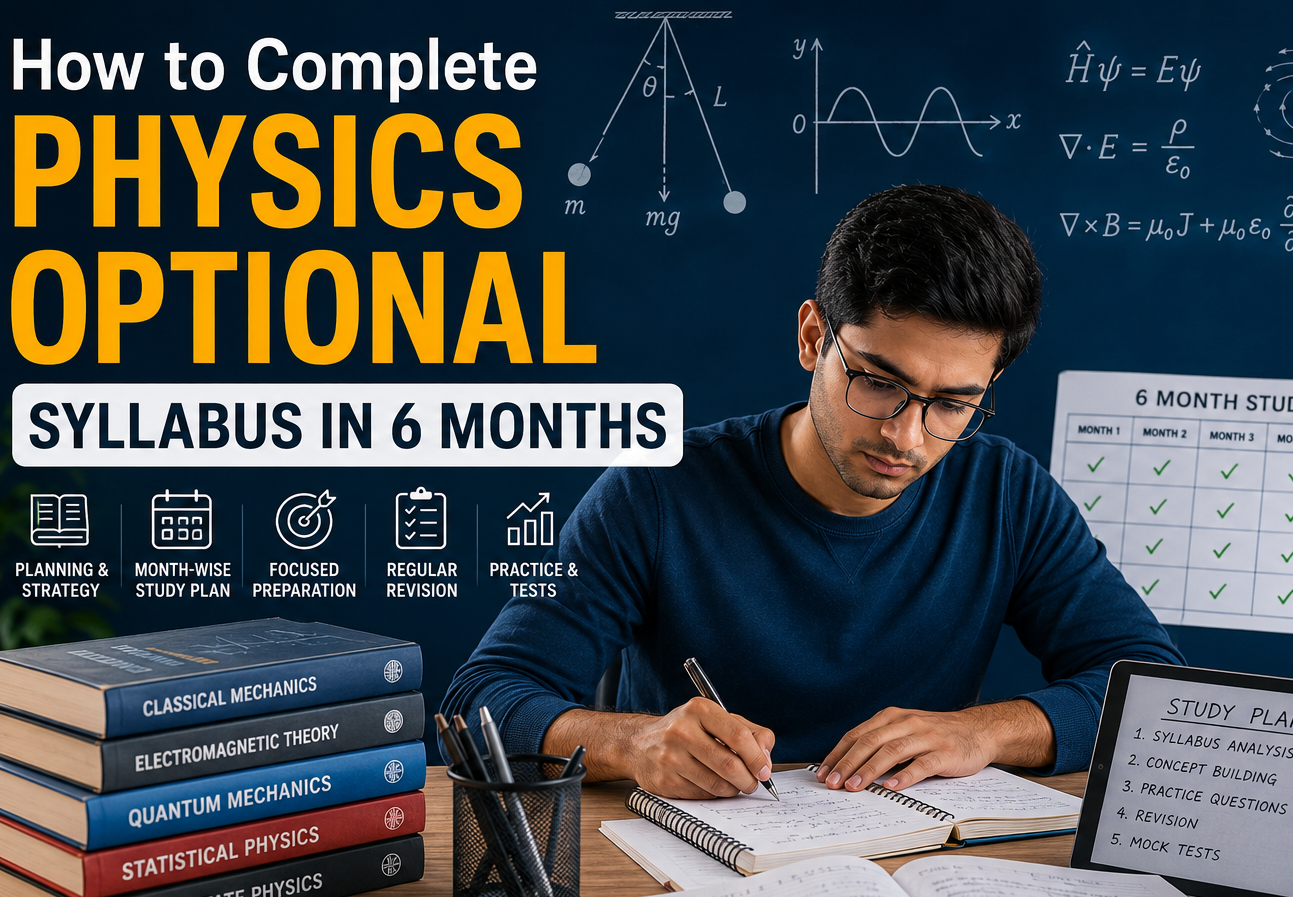
| Month 1–3 | Complete syllabus |
| Month 4 | Topic-wise PYQs |
| Month 5 | Full-length test papers |
| Month 6 | Revision + Mock Tests |
Following this structured approach improves conceptual understanding and examination confidence.
Frequently Asked Questions (FAQs)
How many years of Physics Optional PYQs should I solve?
It is recommended to solve at least the last 10–12 years of UPSC Physics Optional Previous Year Questions.
Are previous year questions enough for Physics Optional preparation?
No. PYQs should be combined with standard textbooks, revision notes, and mock tests for comprehensive preparation.
Which topics are most important based on PYQ analysis?
Mechanics, Electromagnetism, Quantum Mechanics, Thermodynamics, and Electronics have consistently carried high weightage.
Should I solve PYQs topic-wise or year-wise?
Start with topic-wise practice to strengthen concepts, then move to year-wise papers to simulate the actual examination.
How can I improve my score using PYQs?
Analyze mistakes, revise important concepts, practice answer writing, and regularly revisit recurring topics.
Analyzing UPSC Physics Optional Previous Year Questions (2013–2025) is one of the most effective ways to prepare for the UPSC Mains examination. It helps aspirants identify high-weightage topics, understand examiner expectations, and refine their preparation strategy.
When combined with a thorough understanding of the syllabus, quality notes, structured courses, and regular revision, PYQ analysis becomes a powerful tool for achieving a high score in Physics Optional.
If you are serious about maximizing your performance, make previous year question practice an integral part of your daily study routine and use it alongside expert guidance from Quantum IAS.