Choosing the right optional subject is one of the most important decisions in the UPSC Civil Services Examination. Among science and engineering graduates, Physics Optional vs Mathematics Optional is a common debate. Both subjects have a reputation for being analytical, objective, and scoring, but each comes with its own challenges and advantages.
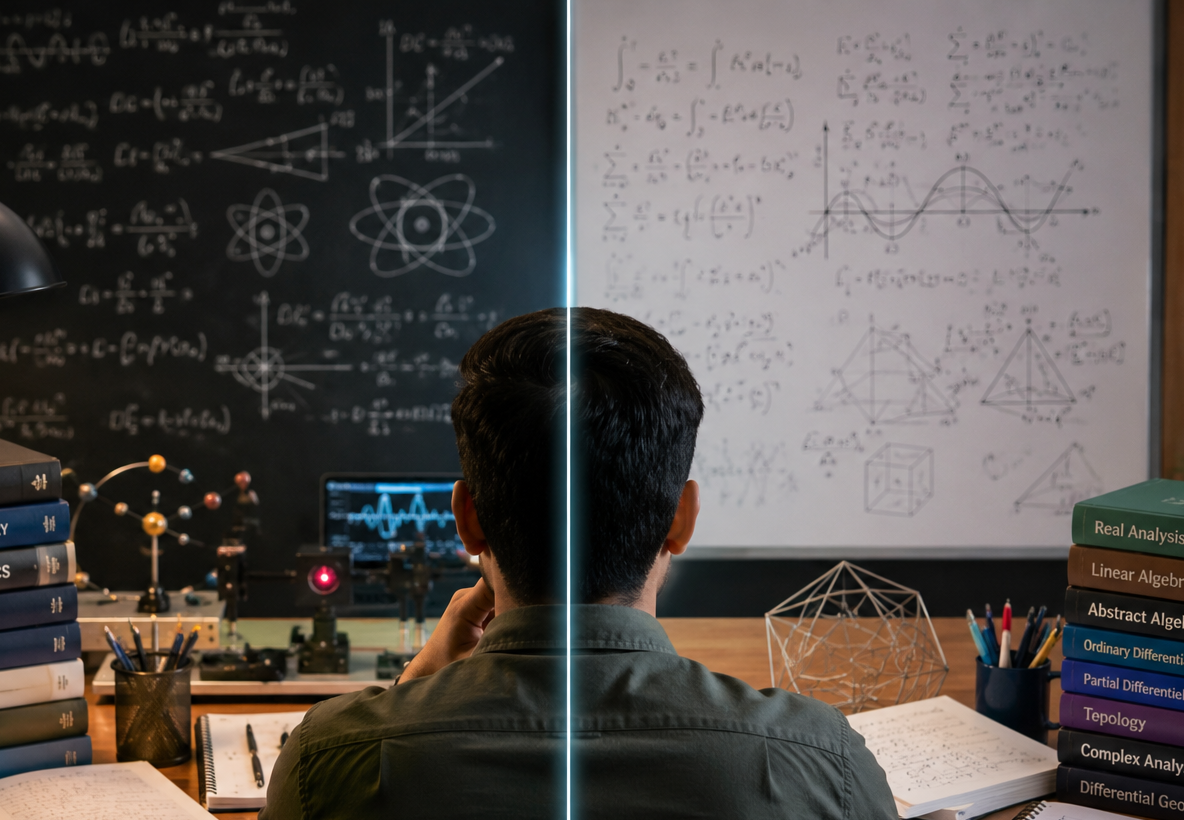
So, which optional should you choose in 2026? In this detailed comparison, we'll analyze the syllabus, scoring potential, preparation strategy, overlap, booklist, and career suitability to help you make an informed decision.
Physics Optional vs Mathematics Optional at a Glance
| Feature | Physics Optional | Mathematics Optional |
|---|---|---|
| Syllabus Length | Moderate | Very Vast |
| Conceptual Difficulty | High | Very High |
| Numerical Problems | Yes | Extensive |
| Theory Questions | Yes | Very Limited |
| Diagram-Based Answers | Yes | No |
| Formula Memorization | Moderate | High |
| Scoring Potential | Very High | Very High |
| Suitable For | Physics & Engineering Graduates | Mathematics & Engineering Graduates |
What is Physics Optional?
Physics Optional is a popular optional subject among engineering and science graduates because of its objective nature and structured syllabus.
Before selecting Physics Optional, understand the complete Physics Optional Syllabus.
The syllabus includes:
Mechanics
Waves & Oscillations
Optics
Electromagnetism
Thermodynamics
Statistical Physics
Quantum Mechanics
Atomic Physics
Nuclear Physics
Electronics
What is Mathematics Optional?
Mathematics Optional is entirely problem-solving based and requires strong mathematical fundamentals.
Major topics include:
Linear Algebra
Calculus
Differential Equations
Real Analysis
Complex Analysis
Mechanics
Statistics
Numerical Analysis
Mathematics has very little theoretical writing but demands exceptional speed and accuracy.

Syllabus Comparison
| Criteria | Physics | Mathematics |
|---|---|---|
| Number of Topics | Moderate | Large |
| Theory Portion | Yes | Very Little |
| Numerical Questions | Moderate | Extensive |
| Formula Load | Medium | Very High |
| Conceptual Understanding | High | Very High |
If you prefer conceptual learning combined with numerical applications, Physics may be more suitable. If you enjoy solving advanced mathematical problems for long hours, Mathematics can be a strong choice.
Difficulty Level
Physics Optional
Physics combines theoretical concepts with derivations and numerical problems. Aspirants need conceptual clarity along with analytical thinking.
Pros
Objective evaluation
Well-defined syllabus
Strong scoring potential
Predictable question pattern
Challenges
Complex derivations
Numerical accuracy
Conceptual depth
Mathematics Optional
Mathematics requires continuous practice and exceptional problem-solving skills.
Pros
Highly objective marking
No essay-style answers
Very high scoring potential
Challenges
Vast syllabus
Time-consuming preparation
Intensive calculation practice
Scoring Potential
| Criteria | Physics | Mathematics |
|---|---|---|
| Objective Evaluation | ✅ | ✅ |
| High Marks Possible | ✅ | ✅ |
| Answer Writing Required | Moderate | Minimal |
| Diagram Usage | Yes | No |
Both subjects are capable of producing excellent scores when prepared well.
Time Required for Preparation
| Preparation Stage | Physics | Mathematics |
|---|---|---|
| Concept Building | 3–4 Months | 4–5 Months |
| Practice | 2 Months | 3 Months |
| Revision | 1 Month | 1 Month |
Physics generally requires slightly less preparation time than Mathematics due to its relatively smaller syllabus.
Best Books for Physics Optional
Choosing the right books is essential for effective preparation.
Read our detailed guide on Best Books for Physics Optional UPSC 2026.
Recommended books include:
Goldstein
Griffiths
Ajoy Ghatak
Zemansky
Arthur Beiser
Kittel
Importance of Physics Optional Notes
Quick revision plays a vital role in Physics preparation.
Use concise Physics Optional Notes for regular revision.
Benefits include:
Formula revision
Concept summaries
Faster revision
Better retention
Practice Previous Year Questions
Previous Year Questions help aspirants understand UPSC trends.
Practice Physics Optional PYQ Solutions Topic Wise regularly.
Benefits:
Better answer writing
Time management
Identification of important topics
Coaching or Self-Study?
Many aspirants successfully prepare through self-study, while others prefer structured mentorship.
Students can explore:
Who Should Choose Physics Optional?
Choose Physics Optional if you:
Have a Physics or Engineering background
Enjoy conceptual learning
Like solving numerical problems
Prefer objective evaluation
Can dedicate time to derivations and diagrams
Who Should Choose Mathematics Optional?
Choose Mathematics Optional if you:
Have a strong mathematical background
Love solving analytical problems
Are comfortable with long calculations
Enjoy practicing questions daily
Physics vs Mathematics: Final Comparison
| Feature | Physics | Mathematics |
|---|---|---|
| Easier to Complete | ✅ | ❌ |
| Better Conceptual Balance | ✅ | ❌ |
| Heavy Calculation | Moderate | Very High |
| Diagram-Based Questions | Yes | No |
| Formula Load | Medium | High |
| Overall Difficulty | High | Very High |
Frequently Asked Questions (FAQs)
Which optional is easier: Physics or Mathematics?
Physics is generally considered easier to complete because its syllabus is relatively smaller and includes conceptual explanations along with numerical problems.
Which optional has better scoring potential?
Both Physics and Mathematics have excellent scoring potential when prepared thoroughly.
Can engineering students choose Physics Optional?
Yes. Physics Optional is one of the most preferred optional subjects among engineering graduates due to its analytical nature.
Is Mathematics Optional tougher than Physics Optional?
For many aspirants, Mathematics is considered more demanding because of its extensive syllabus and intensive problem-solving requirements.
Which optional requires more revision?
Both subjects require regular revision, but Mathematics often demands more continuous practice due to the larger syllabus.
Final Verdict
The choice between Physics Optional vs Mathematics Optional depends on your academic background, interest, and preparation style.
If you enjoy understanding physical concepts, solving numerical problems, and presenting structured answers with diagrams, Physics Optional is an excellent choice.
If you have exceptional mathematical skills and enjoy solving advanced analytical problems, Mathematics Optional can also be highly rewarding.
For aspirants planning to choose Physics Optional, Quantum IAS offers comprehensive study material, expert mentorship, answer writing guidance, and structured courses designed to maximize your UPSC Mains score.
Explore Physics Optional Courses:
With the right optional subject and a disciplined preparation strategy, you can significantly improve your chances of securing a top rank in UPSC Civil Services Examination.