Cracking the UPSC Civil Services Examination (CSE) in your first attempt is the dream of every aspirant. Every year, hundreds of candidates secure top ranks on their first try—not because they study more than others, but because they study smarter, stay consistent, and follow a well-planned strategy.
The UPSC CSE is one of India's toughest competitive examinations, testing not only your knowledge but also your discipline, decision-making, analytical ability, and perseverance. While the journey may seem overwhelming, it becomes much more manageable when broken into clear, achievable stages.
In this guide, you'll learn a practical roadmap to crack UPSC CSE in your first attempt, covering UPSC preparation strategy, time management, study resources, answer writing, revision, and common mistakes to avoid.
Is It Possible to Crack UPSC CSE in the First Attempt?
Absolutely.
Every year, several toppers clear the examination in their first attempt by focusing on:
Understanding the UPSC syllabus thoroughly
Building strong conceptual clarity
Following a disciplined study routine
Practicing answer writing consistently
Revising regularly
Success depends more on strategy and consistency than the number of study hours.
Understand the UPSC Examination Pattern
Before starting your preparation, understand the three stages of the examination.
Stage 1: Preliminary Examination
Two objective papers
General Studies Paper I
CSAT (Qualifying)
Focus on concept clarity and extensive MCQ practice.
Stage 2: Main Examination
The Mains examination consists of descriptive papers that evaluate your analytical thinking, writing skills, and subject knowledge.
Important components include:
Essay
General Studies Papers
Optional Subject Papers
Language Papers
Choosing the right optional subject plays a significant role in your final score.
Stage 3: Personality Test (Interview)
The interview evaluates:
Communication skills
Decision-making ability
Leadership qualities
Awareness of current affairs
Overall personality
Step 1: Know the UPSC Syllabus Thoroughly
Never start preparation without understanding the syllabus.
The syllabus acts as your roadmap and helps you:
Eliminate unnecessary reading
Focus on important topics
Select appropriate study material
Plan revision effectively
Print the syllabus and keep it with you throughout your preparation.
Step 2: Choose the Right Optional Subject
The optional subject contributes 500 marks in the UPSC Mains examination.
Choose an optional based on:
Educational background
Interest
Availability of study material
Guidance and mentorship
Previous performance trends
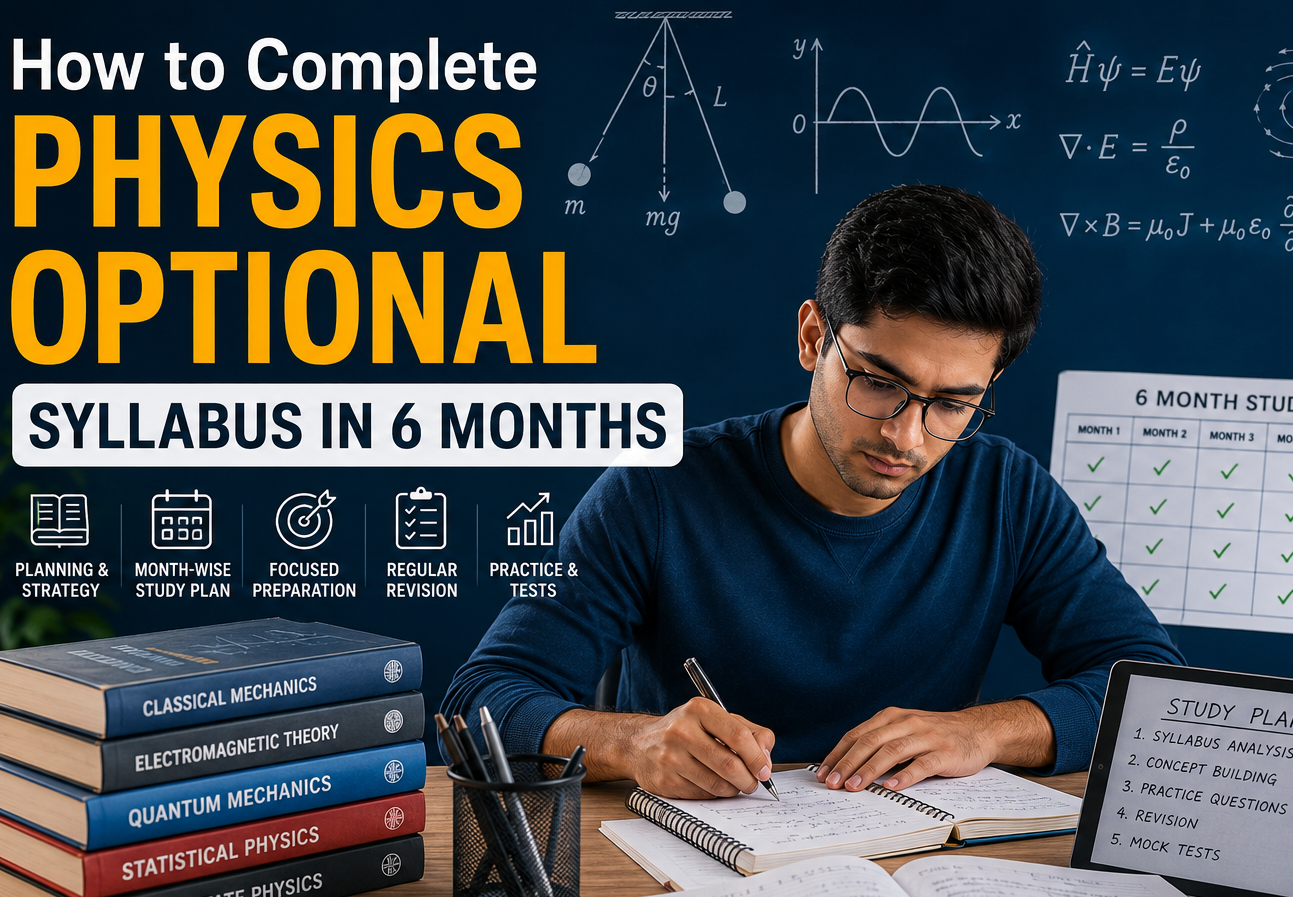
Candidates with a Physics or Engineering background often find Physics Optional to be a rewarding choice due to its logical structure and objective nature.
Step 3: Build Strong Fundamentals
Begin with NCERT books before moving to advanced reference books.
Focus on:
History
Geography
Polity
Economy
Environment
Science & Technology
Strong fundamentals make advanced topics much easier to understand.
Step 4: Create a Realistic Study Plan
Consistency is more important than studying for 12–15 hours occasionally.
Sample Daily Schedule
| Time | Activity |
|---|---|
| 2 Hours | General Studies |
| 2 Hours | Optional Subject |
| 1 Hour | Current Affairs |
| 1 Hour | Revision |
| 1 Hour | Answer Writing / MCQs |
Customize the schedule according to your strengths and availability.
Step 5: Focus on Current Affairs
Read a reliable newspaper every day.
Prepare concise notes on:
National Issues
International Relations
Economy
Environment
Science & Technology
Government Schemes
Monthly current affairs revision is equally important.
Step 6: Practice Answer Writing Early
Many aspirants postpone answer writing until the last few months.
This is a mistake.
Regular answer writing helps improve:
Presentation
Speed
Structure
Analytical thinking
Time management
Practice writing answers in the format expected by UPSC.
Step 7: Solve Previous Year Questions
Previous Year Questions help you understand:
UPSC trends
Frequently asked topics
Difficulty level
Answer expectations
Analyze both Prelims and Mains PYQs regularly.
Step 8: Revise Multiple Times
Revision transforms information into long-term memory.
Follow the 3-Revision Rule:
First Revision
Within one week of completing a topic.
Second Revision
At the end of every month.
Final Revision
Before the examination.
Maintain:
Short notes
Mind maps
Formula sheets (for optional subjects)
Current affairs notebooks
Step 9: Take Mock Tests
Mock tests help you:
Improve speed
Manage time
Identify weak areas
Reduce exam anxiety
Build confidence
Attempt:
Full-length Prelims tests
Mains answer writing tests
Optional subject test series
Step 10: Stay Consistent
UPSC preparation is a marathon, not a sprint.
Avoid:
Comparing yourself with others
Constantly changing study plans
Reading too many books
Following multiple coaching materials simultaneously
Small, consistent improvements every day lead to long-term success.
Common Mistakes to Avoid
Ignoring the syllabus
Reading too many resources
Skipping revision
Delaying answer writing
Neglecting Previous Year Questions
Not taking mock tests
Studying without a timetable
Ignoring physical and mental health
Best Resources for UPSC Preparation
A limited number of quality resources is sufficient.
Include:
NCERT Books
Standard Reference Books
Previous Year Questions
Daily Newspaper
Monthly Current Affairs
Mock Tests
Optional Subject Study Material

How Physics Optional Can Improve Your UPSC Score
If you have a Physics or Engineering background, Physics Optional offers several advantages:
Concept-based preparation
Objective evaluation
Limited syllabus compared to many humanities optionals
Strong scoring potential
Predictable question pattern
With structured guidance, regular practice, and expert mentorship, Physics Optional can become a major contributor to your final UPSC rank.
Why Choose Quantum IAS?
Quantum IAS provides a focused learning environment for aspirants preparing Physics Optional for UPSC.
Students benefit from:
Experienced faculty
Comprehensive study material
Answer Writing Evaluation
Live & Recorded Classes
Whether you're preparing for your first attempt or looking to improve your score, Quantum IAS offers structured guidance designed to help you succeed.
Frequently Asked Questions (FAQs)
Can I crack UPSC in my first attempt?
Yes. Every year, many aspirants clear UPSC in their first attempt by following a disciplined study plan and consistent revision.
How many hours should I study daily?
Quality matters more than quantity. A focused 6–8 hours of productive study is sufficient for most aspirants.
Is coaching necessary to crack UPSC?
Coaching is not mandatory, but structured guidance, mentorship, and regular evaluation can make preparation more efficient.
When should I start answer writing?
Begin answer writing as soon as you complete the basic understanding of the syllabus. Don't wait until the final months.
How important is the optional subject?
The optional subject contributes 500 marks in the UPSC Mains examination and can significantly influence your final rank.
Cracking the UPSC CSE in your first attempt is not about studying endlessly—it's about following the right strategy, staying disciplined, revising consistently, and continuously improving through practice.
Build strong fundamentals, understand the syllabus, practice answer writing, solve Previous Year Questions, and choose your optional subject wisely. Most importantly, remain patient and trust the process.
With consistent effort, the right guidance, and a structured preparation strategy, your first attempt can become your successful attempt.