 UPSC Guide
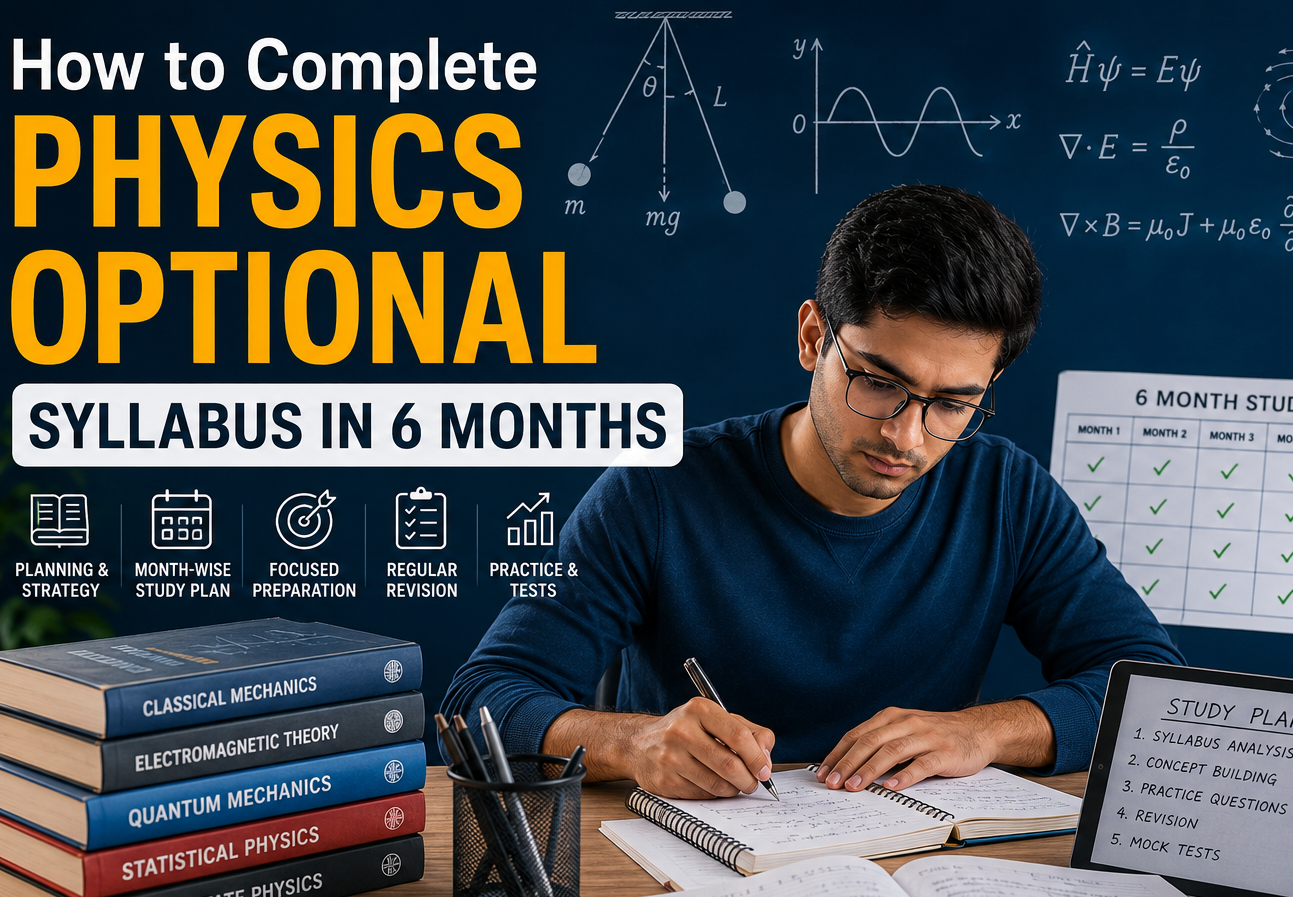
How to Complete Physics Optional Syllabus in 6 Months
Completing the Physics Optional Syllabus in 6 Months may seem challenging at first, but with a well-structured study plan, disciplined execution, and consistent revision, it is absolutely achievable. Every year, many UPSC toppers complete the Physics Optional for UPSC syllabus within six months by focusing on conceptual clarity, regular practice, and smart revision instead of studying randomly.Whether you are a beginner, a working professional, or a repeat aspirant, following a month-wise strategy can help you complete the syllabus confidently while leaving sufficient time for revision and mock tests.In this guide, we'll discuss a practical 6-month Physics Optional preparation strategy, recommended study resources, common mistakes to avoid, and expert tips to maximize your score in UPSC Mains.Why Follow a 6-Month Plan for Physics Optional?A structured preparation schedule helps aspirants complete the syllabus without unnecessary stress.Benefits of a 6-Month Study PlanCovers the complete syllabus systematicallyProvides enough time for multiple revisionsImproves conceptual understandingEnhances numerical problem-solving skillsIncludes answer writing and mock test practiceReduces last-minute pressure before UPSC MainsBefore beginning your preparation, thoroughly understand the Physics Optional UPSC Syllabus to know exactly what UPSC expects from aspirants.Is It Possible to Complete Physics Optional in 6 Months?Yes. Completing the syllabus in six months is realistic if you:Study consistently for 4–6 hours daily.Follow a fixed timetable.Use limited but standard reference books.Practice Previous Year Questions regularly.Revise every week.Attempt mock tests before the examination.The key is consistency rather than studying excessively for a few days.Month-Wise Physics Optional Preparation PlanMonthTopicsGoalMonth 1Mathematical Methods, Mechanics & RelativityBuild Conceptual FoundationMonth 2Electricity & MagnetismComplete High-Weightage TopicsMonth 3Quantum Mechanics, Atomic & Nuclear PhysicsStrengthen Paper IIMonth 4Thermodynamics, Optics, Statistical Physics & ElectronicsComplete Entire SyllabusMonth 5PYQs, Revision & Answer WritingImprove AccuracyMonth 6Mock Tests & Final RevisionExam-Oriented PreparationMonth 1: Build Your FoundationThe first month determines the quality of your entire preparation.Topics to CoverMathematical MethodsClassical MechanicsSpecial Theory of RelativityPreparation StrategyUnderstand concepts instead of memorizing.Prepare short notes.Solve basic numerical problems.Practice derivations.Complete chapter-wise Previous Year Questions.A strong understanding of Mechanics makes many advanced topics easier to learn.Month 2: Master Electricity & MagnetismElectricity and Magnetism consistently carry significant weight in the UPSC examination.TopicsElectrostaticsGauss's LawElectric PotentialMagnetostaticsMaxwell's EquationsElectromagnetic WavesDaily Routine3 Hours Theory2 Hours Numerical Practice1 Hour RevisionFocus on understanding derivations rather than simply memorizing formulas.Month 3: Quantum Mechanics, Atomic & Nuclear PhysicsQuantum Mechanics is one of the highest-scoring sections in Physics Optional.TopicsSchrödinger EquationWave FunctionOperatorsHydrogen AtomAtomic SpectraNuclear ModelsRadioactivityStudy TipsSolve conceptual questions daily.Practice derivations.Revise formulas regularly.Solve topic-wise PYQs after every chapter.Month 4: Complete the Remaining SyllabusFocus on completing the remaining Paper I and Paper II topics.TopicsThermodynamicsLaws of ThermodynamicsCarnot CycleEntropyHeat EnginesStatistical PhysicsMaxwell-Boltzmann StatisticsBose-Einstein StatisticsFermi-Dirac StatisticsOpticsInterferenceDiffractionPolarizationOptical InstrumentsElectronicsDiodesTransistorsAmplifiersOscillatorsDigital ElectronicsBy the end of Month 4, the complete syllabus should be finished.Month 5: Revision, PYQs & Answer WritingThis month is dedicated to strengthening your preparation.ActivitiesRevise complete notes.Solve the last 15–20 years of UPSC Previous Year Questions.Practice answer writing every day.Improve diagrams and derivations.Attempt sectional mock tests.This phase helps improve both speed and presentation.Month 6: Final Revision & Mock TestsThe final month should focus only on revision.PrioritiesFull-length mock tests.Formula revision.Error analysis.Weak topic improvement.Time management.Quick revision using short notes.Avoid beginning any new topic during the final month.Weekly Study PlanDayActivityMondayLearn New TopicsTuesdayNumerical PracticeWednesdayTheory RevisionThursdayPrevious Year QuestionsFridayAnswer Writing PracticeSaturdayMock TestSundayRevision & Weak AreasDaily Study ScheduleTimeTask2 HoursTheory2 HoursNumerical Problems1 HourPrevious Year Questions1 HourRevisionThis schedule can also be followed by working professionals with minor adjustments.Importance of Previous Year QuestionsPrevious Year Questions help aspirants understand the actual UPSC examination pattern.Benefits include:Identifying frequently asked topicsUnderstanding question trendsImproving answer-writing skillsBuilding confidence before MainsPractice at least 15 years of topic-wise PYQs before the examination.Develop Strong Answer Writing SkillsMany aspirants lose marks despite having good conceptual knowledge.Practice writing answers with:Proper derivationsNeat diagramsMathematical notationGraphs where applicableTime-bound practiceConsistent answer writing significantly improves your final score.Best Books for Physics OptionalUsing too many books often leads to confusion. Instead, stick to standard references.Recommended BooksGoldstein – Classical MechanicsGriffiths – ElectromagnetismGriffiths – Quantum MechanicsAjoy Ghatak – OpticsZemansky – ThermodynamicsArthur Beiser – Atomic PhysicsKittel – Solid State PhysicsRevision StrategyRevision should never be postponed until the end.Follow these practices:Weekly revisionMonthly revisionFormula sheetsShort notesError notebookThree complete revisions before UPSC MainsRegular revision helps retain concepts and improves recall during the examination.Common Mistakes to AvoidStudying without a timetableIgnoring Mathematical MethodsSkipping Previous Year QuestionsDelaying answer writing practiceReading too many booksNot revising regularlyAvoiding mock testsAvoiding these mistakes can significantly improve your preparation.Why Choose Quantum IAS?Preparing Physics Optional for UPSC becomes much easier with expert guidance and structured study material.Quantum IAS offers:Experienced Physics FacultyComprehensive Study NotesTopic-wise Previous Year Question DiscussionsLive & Recorded ClassesRegular Test SeriesPersonalized MentorshipAnswer Writing EvaluationPerformance TrackingWhether you are starting from scratch or aiming to improve your previous score, Quantum IAS provides a complete learning ecosystem for Physics Optional aspirants.Frequently Asked Questions (FAQs)Can I complete Physics Optional in six months?Yes. With a disciplined study plan, consistent revision, and regular PYQ practice, six months is sufficient for most aspirants.How many hours should I study daily?A dedicated 4–6 hours per day for Physics Optional is generally recommended.Should I solve Previous Year Questions?Absolutely. Previous Year Questions help identify important topics and improve exam-oriented preparation.Is answer writing necessary?Yes. Regular answer writing improves presentation, speed, and overall scoring potential.Should I join coaching or mentorship?A structured coaching program or mentorship can provide guidance, doubt resolution, performance evaluation, and accountability, making preparation more effective.Completing the Physics Optional Syllabus in 6 Months is completely achievable with a systematic study plan, consistent revision, regular answer writing, and continuous practice of Previous Year Questions. Instead of rushing through the syllabus, focus on building conceptual clarity and revising multiple times.If you're looking for structured preparation, expert mentorship, comprehensive study material, and a proven roadmap to success, Quantum IAS provides everything you need to excel in Physics Optional for UPSC and maximize your score in the UPSC Civil Services Examination.